The Gunpowder Plot was planned in 1605, it was a failed assassination attempt against King James I of England and VI of Scotland by a group of provincial English Catholics led by Robert Catesby and other men such as Guy Fawkes.
The plan was to blow up the House of Lords during the State Opening of England's Parliament on 5 November 1605 but it failed. Since then, English people celebrate "The bonfire night" every november 5th.
The Gunpowder Plot took place during the context of the English Revolution.
1- Which dinasty ruled England after Elisabeth I died?
2- Why did the catholics plan the Gunpowder plot?
3- Why was James I dragged into the 30 Years' War?
4- Who succeeded James I?
5- Whom did the new king have problems with?
6- When did the Civil War start? Who fought in it? Where did the parts have supports?
7- What happened with Charles I?
8-Who succeeded Charles? What did he do with Ireland and Scotland?
9- What happened in May, 1660? and in 1665 and 1666?
10- What did people suspect about James II?
11- Who was William of Orange?
12- What was the "Act of Settlement"? What did it permit in 1714?
Watch a video and play games about the Gun Powder Plot here
Find out more of the bonfire night in this blog of our neighbours of Sto Tomé school:
2- Look for information about (a few words and lot of images please):
BISMARCK
LIVINGSTONE-STANLEY
SUEZ CANAL
3- Visit the page of British Lybrary that permit you to read old newspapers, select one, for example, The News of the world, and look for news about colonialism, for example in 1886. Choose one and write a brief comment (summarysing and explaining it).
4- Listen this song, what are they talking about?
Doctor Livingston, I presume, Stepping out of the jungle gloom Into the midday sun. What did you find there? Did you stand awhile and stare? Did you meet anyone?
"I've seen butterflies galore, I've seen people big and small, I've still not found what I'm looking for."
We're all looking for someone. We're all looking for someone. We're all looking for someone.
Captain Scott, you were so bold, Now you're looking rather cold Out there in the snow. What did you find there? Did you stand awhile and stare? Did you meet anyone?
"I've seen polar bears and seals, I've seen giant Antarctic eels, I've still not found what I'm looking for."
We're all looking for someone. We're all looking for someone. We're all looking for someone.
Columbus, where are you bound? So you think the world is round. Sailed off in the blue. What did you find there? Did you stand awhile and stare? Did you meet anyone?
"There are Indians by the score In many places that I saw. I've still not found what I'm looking for."
We're all looking for someone. We're all looking for someone. We're all looking for someone.
Interesante traballo das nosas alumnas Iria e Sandra (alumnas tamén de tecnoloxía) sobre o funcionamento dunha locomotora a vapor, protagonista da 1ª revolución industrial.
The Industrial Revolution caused the spread of industrial capitalism. This new system meant to have a constant and increasing economic growth never seen before but also to have cyclical crises. We are going to talk about two of these crises, which were possibly the hardest in the last 100 years.
THE WALL STREET CRASH, OCTOBER, 1929
Crowd gathering on Wall St. after the 1929 crash KEY WORDS:
"The Wall Street Crash of 1929 (October 1929), also known as the Great Crash, and the Stock Market Crash of 1929, was the most devastating stock market crash in the history of the United States, taking into consideration the full extent and duration of its fallout. The crash began a 10-year economic slump that affected all the Western industrialized countries.
The Roaring Twenties, the decade that led up to the Crash, was a time of wealth and excess. Despite caution of the dangers of speculation, many believed that the market could sustain high price levels. Shortly before the crash, economist Irving Fisher famously proclaimed, "Stock prices have reached what looks like a permanently high plateau." However, the optimism and financial gains of the great bull market were shattered on "Black Tuesday", October 29, 1929, when share prices on the New York Stock Exchange (NYSE) collapsed. Stock prices plummeted on that day, and continued to fall at an unprecedented rate for a full month.
The October 1929 crash came during a period of declining real estate values in the United States (which peaked in 1925) near the beginning of a chain of events that led to the Great Depression, a period of economic decline in the industrialized nations.
In the days leading up to "Black Thursday" (called "Black Friday" in Europe due to the time difference) and "Black Tuesday" the following week, the market was severely unstable. Periods of selling and high volumes of trading were interspersed with brief periods of rising prices and recovery. After the crash, the Dow Jones Industrial Average (DJIA) partially recovered in November–December 1929 and early 1930, only to reverse and crash again, reaching a low point of the great bear market in 1932. On July 8, 1932, the Dow reached its lowest level of the 20th century and did not return to pre-1929 levels until November 1954."
Watch this video:
THE FINANCIAL CRISIS, 2007
KEY WORDS:
MORTGAGE, LEND-BORROW, FORECLOSURES, HOUSING BUBLE, CENTRAL BANKS, BAILOUT, LIQUIDITY
The wikipedia says:
"The financial crisis of 2007 to the present is a crisis triggered by a liquidity shortfall in the United States banking system. It has resulted in the collapse of large financial institutions, the bailout of banks by national governments, and downturns in stock markets around the world. In many areas, the housing market has also suffered, resulting in numerous evictions, foreclosures and prolonged vacancies. It is considered by many economists to be the worst financial crisis since the Great Depression of the 1930s. It contributed to the failure of key businesses, declines in consumer wealth estimated in the hundreds of trillions of U.S. dollars, substantial financial commitments incurred by governments, and a significant decline in economic activity. Many causes have been suggested, with varying weight assigned by experts. Both market-based and regulatory solutions have been implemented or are under consideration, while significant risks remain for the world economy over the 2010–2011 periods.
The collapse of the housing bubble, which peaked in the U.S. in 2006, caused the values of securities tied to real estate pricing to plummet thereafter, damaging financial institutions globally. Questions regarding bank solvency, declines in credit availability, and damaged investor confidence had an impact on global stock markets, where securities suffered large losses during late 2008 and early 2009. Economies worldwide slowed during this period as credit tightened and international trade declined. Critics argued that credit rating agencies and investors failed to accurately price the risk involved with mortgage-related financial products, and that governments did not adjust their regulatory practices to address 21st century financial markets.Governments and central banks responded with unprecedented fiscal stimulus, monetary policy expansion, and institutional bailouts."
Watch this video:
Well, after reading all of this information that you were giving, could you...?
- Make a short framework with causes and consequences of:
The Crash, 1929 the Financial Crisis, 2007
- Do you find some similarities between the two crises?
We are going to watch this video at the classroom and answer some questions:
- Who was John Lennon? - When was he born? When did he die? How? - What hapenned in the US in the sixties? Why does Lennon talk so much about peace? - Who is Yoko Ono?
is the British Library’s page that permits to read old newspapers. Select The Manchester Guardian and look for news about industry in 1851. Find out more about Manchester’s city in 1851, location, population and its main industry.
3- Visit this web-site and find out more about children life in Victorian times, during the industrial revolution:
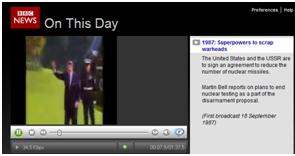
The United States and the USSR are to sign an agreement later this year to reduce the number of nuclear missiles. US President Ronald Reagan announced the news that over 1,000 weapons would be scrapped over the next few years. The superpower summit in Washington will be the first ever treaty reducing the total number of nuclear arms since their invention 50 years ago. President Reagan said the talks had been "frank, constructive and notable" and Soviet Foreign Minister Eduard Shevardnadze said it was "time to reap the harvest" after moving towards an accord for many years. The arms to be dismantled under the treaty are all short and medium-range missiles based in Europe and the Soviet Union. Even though the reduction only represents a 3% total decrease in the number of nuclear warheads deployed worldwide, peace campaigners welcomed the announcement. The chairman of the Campaign for Nuclear Disarmament said it was the direct result of persistent pressure from the peace movement. Details of the treaty, including the crucial matter of verifying the destruction of the missiles, have yet to be worked out. But US Secretary of State George Shultz said the treaty was only the beginning of the process. "This doesn't solve all the problems by a long shot... But you've got to start," he said.
1) READ AND ANSWER:
- Tell me the meaning of these words (in english and with your own words):
SCRAP, TREATY, WARHEADS, AGREEMENT, WEAPONS, WORK OUT
- Who were the main characters of this piece of news?
- What do "peace campaigners" think about the agreement?
- What does George Schultz think about the treaty?
2) WATCH THIS VIDEO AND IDENTIFY AT LEAST 5 KEY WORDS.